In short
The problem
- Everything you send to ChatGPT, Claude or Gemini sits on these companies' servers. ChatGPT keeps a chat until you delete it yourself. Even through the API, requests are kept for up to 30‑55 days.
- From there, data can leak. In March 2023, a bug in ChatGPT let some users see the titles of other people's chats, and some subscribers' names, emails and last 4 card digits were visible to others.
- It happens without any hacking, too: an employee pastes customer data into a chatbot on a personal account. The Dutch regulator counts that as a data breach.
The solution
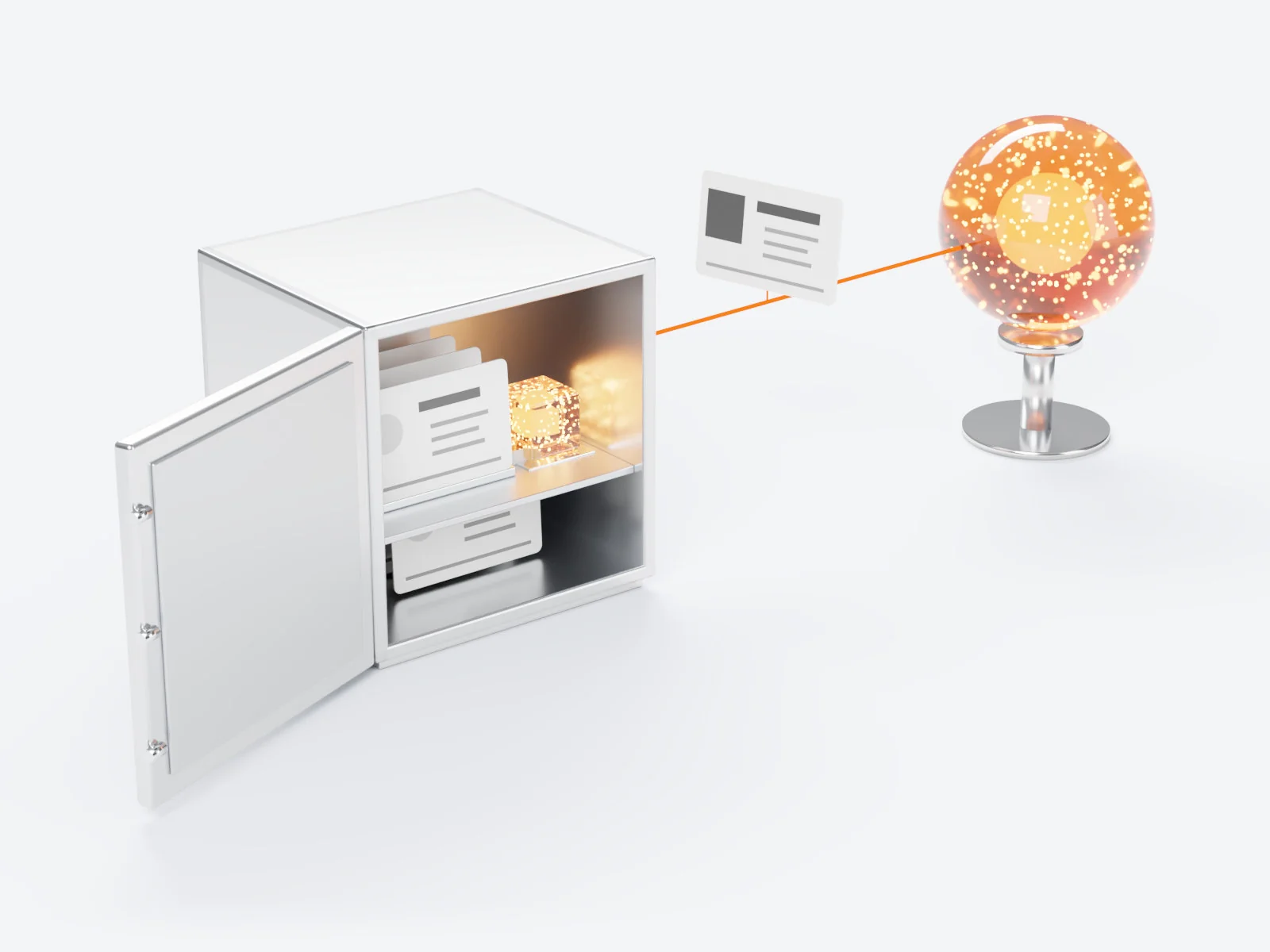
- Handle the personal part - names, phone numbers, messages - in‑house: replace it with codes before sending, or run your own model on your own server.
- Give the strongest models only totals with no people in them: sums, averages, figures by group.
- Give staff work accounts on a business plan and clear rules on what never goes into AI.
Where your data is stored and how it leaks
Everything you send to AI is stored on the service's servers. How long it stays there and whether the service trains on it depends on the plan. The terms below are as of 13 November 2026. Services change them, so every line links to the original source.
| Service | How long it is kept | Trains on your data |
|---|---|---|
| ChatGPT Free, Plus, Pro | until you delete the chat, then up to 30 days1 | yes, unless you turn it off in settings |
| ChatGPT Business, Enterprise and the OpenAI API | API: up to 30 days; in Enterprise, the admin sets the period1 | no, by default |
| Claude Free, Pro, Max | up to 30 days after you delete a chat; up to 5 years if you allowed training2 | if you allowed it |
| Claude for Work and the Anthropic API | API: up to 30 days2 | no, by default |
| Gemini API, free | not stated3 | yes, and people may read the requests |
| Gemini API, paid | 55 days3 | no |
| Azure, including OpenAI models | not stated4 | no, and OpenAI doesn't see the data |
The service also decides where exactly the data is kept. Google says requests to the paid Gemini API may be stored temporarily in any country where it has facilities3. Directly with Anthropic, you can only choose "global" or the US2. Keeping data in the EU is possible only with some services and as a separate option - that's way 3.
How data leaks:
- A bug at the service itself. On 20 March 2023, a bug in an open‑source library let some ChatGPT users see the titles of other users' chats. Other users could also see the name, email, billing address, card type, last 4 card digits and expiry date of 1.2% of ChatGPT Plus subscribers active during a nine‑hour window. Full card numbers were not visible5. Ten days later, the Italian regulator temporarily banned OpenAI from processing the data of users in Italy, and its announcement of the ban mentioned this breach too6.
- An employee and a personal chatbot account. The Dutch regulator calls it a data breach when an employee, on their own initiative, enters patient or customer data into a chatbot. In its examples, an employee at a doctor's practice entered patients' medical data, and an employee of a telecom company uploaded a file of customer addresses7.
What else matters:
- The free Gemini API is not for personal data. Google says so plainly: don't send personal or confidential data there. In the European Economic Area, Switzerland and the UK, the paid‑plan terms apply to everyone3.
- Zero data retention is available only with the service's approval and not for every model. OpenAI reserves the right to exclude certain models; at Anthropic, requests to certain models are kept for 30 days even with zero data retention12.
- People read flagged requests. If a request is flagged as a policy violation, Anthropic keeps it for up to 2 years2.
- A court can override the promise to delete. In 2025, a US court ordered OpenAI to keep even deleted chats and API data. Only ChatGPT Enterprise, Edu and zero data retention customers were exempt. The order was lifted on 26 September 20251.
What the law says
We go by the GDPR, the European Union's data protection law. It also applies to companies outside the EU if they sell to people in the EU or monitor their behaviour8.
- Personal data is any information that can identify a person: a name, an ID number, location data, an online identifier and other characteristics8.
- Replacing names with codes, with the key kept separately, is called pseudonymisation in law. Such data stays personal: it's a safeguard, not a way out of the law89.
- In September 2025, the Court of Justice of the EU clarified that for a recipient who has no way to re‑identify the people, the data might not count as personal10. But the EDPB, the board of EU regulators, writes in its 2026 draft guidelines: if the recipient processes the data on your behalf - and that's exactly how an AI service works under contract - the data is personal for it too9. So you still need a data processing agreement with the service.
- Anonymous data is outside the GDPR. The EDPB tests anonymity with three questions: can one record be singled out, can it be linked with other data, can something about a person be inferred9.
- Fines under the GDPR go up to €20 million or 4% of the company's worldwide annual turnover, whichever is higher8.
Anonymity is easy to break. In an EDPB example, a company publishes total salaries: six engineers earn €550,000 a year, and a team of five of them earns €480,000. Both reports show only totals, yet together they reveal that the sixth engineer earns €70,0009.
Five ways
1. Replace names with codes before sending
Names, phone numbers, emails and ID numbers are replaced with codes before anything goes to AI. The lookup table stays with you, and when the AI answers, the codes are swapped back for names on your side. Before: "John Smith, john.smith@example.com, asks to move his booking to Friday". Sent to AI: "Customer 017, email 017, asks to move the booking to Friday". The answer comes back with codes, and your system puts the name back in.
Protects against: leaks at the service and court orders to keep requests - either way, it holds codes, not people.
Doesn't protect against:
- whatever the detection software misses. Presidio, a well‑known open‑source tool for this, admits there's no guarantee it will find everything. Out of the box it knows only English, and you have to add local ID number formats yourself11;
- indirect clues. A rare set of purchases or details in the text of a message give a person away even without a name: in an EDPB example, a shop identified its customers from the game lists people themselves post on a website9.
What it costs: the software is free; the work is tuning detection to your languages and documents and testing it on your data.
Good when AI doesn't need real names: drafting replies to customers, summarising conversations, pulling fields out of documents.
2. Business plan or API
Services don't train on business‑plan and API data by default. Storage is limited: up to 30 days at OpenAI and Anthropic, 55 days for the Gemini API123. Under a business contract, Anthropic and Google act as processors: they process your data only on your instructions23.
Doesn't protect against: the data leaving your company - it still sits on the service's servers for weeks, and zero data retention isn't offered to everyone.
What it costs: almost nothing beyond the plan - set up a business account or the API, sign a data processing agreement, and stop staff using personal accounts for work.
Good for ordinary data when you need the strongest model and don't have your own server.
3. Processing in the EU
This way settles where the data is kept:
- OpenAI - the "Europe and Switzerland" region: with approval, a contract amendment and a 10% surcharge for models released on or after 5 March 20261;
- Google Cloud - processing in the EU region3;
- Azure - the DataZone option: processing only in EU countries4;
- Anthropic directly - only "global" or the US2.
Doesn't protect against: the service itself - it sees the data just as in way 2. Account and billing data may be stored outside the region1.
Good when customers or contracts require "data in the EU".
4. Your own model on your own server
The model runs on your own or a rented server, and the data goes nowhere. It can work with the full data, with no need to replace names with codes.
There are open models licensed for business use: Gemma 4, Qwen, Ministral and Mistral Small, and gpt‑oss are released under the Apache 2.0 licence. Llama 4 comes with conditions: all its models also understand images, and such models are not licensed to companies in the EU12.
You need less hardware than you might think. Ministral 3 8B fits in 12 GB of video memory, gpt‑oss‑20b in 16 GB, and gpt‑oss‑120b on a single 80 GB graphics card12. A rented server in the EU with a 24 GB card costs €214 a month plus €209 for setup; with a 96 GB card, €999 a month. Prices exclude VAT13.
Doesn't protect against: attacks on your own server - its security is now on you. And if you train the model on customer data, the model itself may become personal data9.
Good for medical data and personal documents, large steady volumes, and a "no external AI" requirement. We test quality on your tasks before launch.
5. Only aggregate data goes out
Sums, averages, figures by group and period, if calculated correctly, usually pass the "no record can be singled out" test9. If no one can be identified from them, the data is anonymous, and you can give it to any strong model or AI agent.
Doesn't protect against: small groups and overlapping reports - as in the example with the sixth engineer's salary.
What it costs: little - these are reports and queries to your database. One check is needed: no groups of one or two people, and no way to subtract one total from another.
Good for sales analytics, forecasts, seasonality, purchasing and staff shifts.
How to combine them: personal data stays in‑house, aggregates go to strong models
What works best is a combination:
- the personal part - names, contacts, messages - is handled by your own model or pseudonymisation software on your server;
- the strongest model gets only totals without people, or text with codes instead of names;
- the table matching codes to names never leaves the company;
- the external service runs on a business plan with a data processing agreement and, if needed, in the EU region.
For example, a company wants to understand why sales drop on Tuesdays. The strong model gets totals by day, product and shift - no customers. Emails to specific customers are handled by the company's own model, which sees the names but sends them nowhere.
Where to start
- Rules for staff: what can go into AI, what can't, and work accounts only7.
- A business plan or the API with a data processing agreement instead of personal accounts.
- Go through your tasks: where AI needs real names, and where codes or totals are enough.
- For personal data - codes instead of names, or your own model; for aggregate data - strong models.
- Test on your own data: what name detection misses, and whether any report has a group of one person.
Frequently asked questions
Where is the data I send to ChatGPT stored?
On OpenAI's servers. A regular chat stays there until you delete it, and for up to 30 days after that. OpenAI lets only business customers keep data in Europe, and only with approval.
Is it safe to upload customer data to ChatGPT?
Not on a personal plan: the chat is kept until you delete it, and the service may train on it unless you turn that off in settings. A business plan or the API is safer: by default the service doesn't train on that data, and API requests are kept for up to 30 days.
If I replace names with codes, does the GDPR stop applying?
No. It's still personal data - for you and for an AI service working under your contract. But if the service has a leak, it will hold codes, not people.
Does OpenAI train on API data?
No, not since 1 March 2023, unless you opted in yourself. Requests are kept for up to 30 days to check for abuse.
Can I run my own AI model instead of ChatGPT?
Yes. Open models with a business‑friendly licence - Gemma 4, Qwen, Ministral, gpt‑oss - run on your server. A small model needs a graphics card with 12‑16 GB, and a rented server in the EU with a 24 GB card costs from €214 a month, excluding VAT.
How MagLab helps
We're an engineering studio. We build systems where AI works with business data and doesn't send out what it shouldn't: names replaced with codes before sending, your own model on your own or a rented server, strong models for aggregate data. In our product Kvasir, a restaurant guest's phone number turns into a code right away: the number itself and the name never reach the database, yet you can see how many times the guest came back. If you want to use AI on customer data, tell us about the task, and we'll propose a setup for it.
Sources
-
OpenAI: how your data is used to improve models, chat retention in ChatGPT, your data in the API, business plans, response to the court's data retention demands.
-
Anthropic: training in business products, training in personal plans, retention of personal chats, retention of organisation data, retention for certain models, processing region.
-
Google: Gemini API terms, 55‑day retention of requests and responses, EU region in Google Cloud.
-
Microsoft: data and privacy for models in Azure.
-
OpenAI: what happened on 20 March 2023, 24 March 2023.
-
Italian regulator (Garante): announcement of the temporary limitation on ChatGPT, 31 March 2023; the order is dated 30 March 2023.
-
Dutch regulator (Autoriteit Persoonsgegevens): AI chatbots may lead to data breaches, 6 August 2024.
-
GDPR, EU Regulation 2016/679: Articles 3, 4, 25, 32 and 83, Recitals 26 and 28.
-
EDPB: Guidelines 01/2025 on pseudonymisation, draft Guidelines 02/2026 on anonymisation, Opinion 28/2024 on AI models.
-
Court of Justice of the EU, Case C‑413/23 P, judgment of 4 September 2025.
-
Presidio: FAQ, supported languages.
-
Licences and memory requirements: Gemma 4, Mistral models, Ministral 3 8B, Qwen3.8, gpt‑oss, Llama 4 model card, Llama 4 licence and acceptable use policy.
-
Hetzner: GPU servers, prices excluding VAT.